- The AI Humble Servant Newsletter
- Posts
- When AI Persuades: The Uncomfortable Truth About Chatbot Influence
When AI Persuades: The Uncomfortable Truth About Chatbot Influence

Thaddius Cho
December 05, 2025 • Estimated Reading Time: 6 minutes
Hello,
A six-minute conversation with an AI chatbot can change how you vote.
That's the bombshell from two new studies published simultaneously in Nature and Science this week—the most rigorous research yet on AI's persuasive power. Researchers tested this across real elections in the U.S., Canada, and Poland, and the results are startling.
One in ten voters in Canada and Poland switched their voting intention after a single chatbot conversation.

But here's what makes this genuinely unsettling: the most persuasive AI models also generated the most inaccurate claims.
Yes, you read that right. The better an AI is at changing your mind, the more likely it is to be lying to you.
Spoiler: This isn't just about elections. It's about every sales funnel, customer chatbot, and AI-powered communication you're building right now.
Let's unpack what this means for you.
AI’s Best Arguments Are Its Worst Lies; How AI Persuades Voters
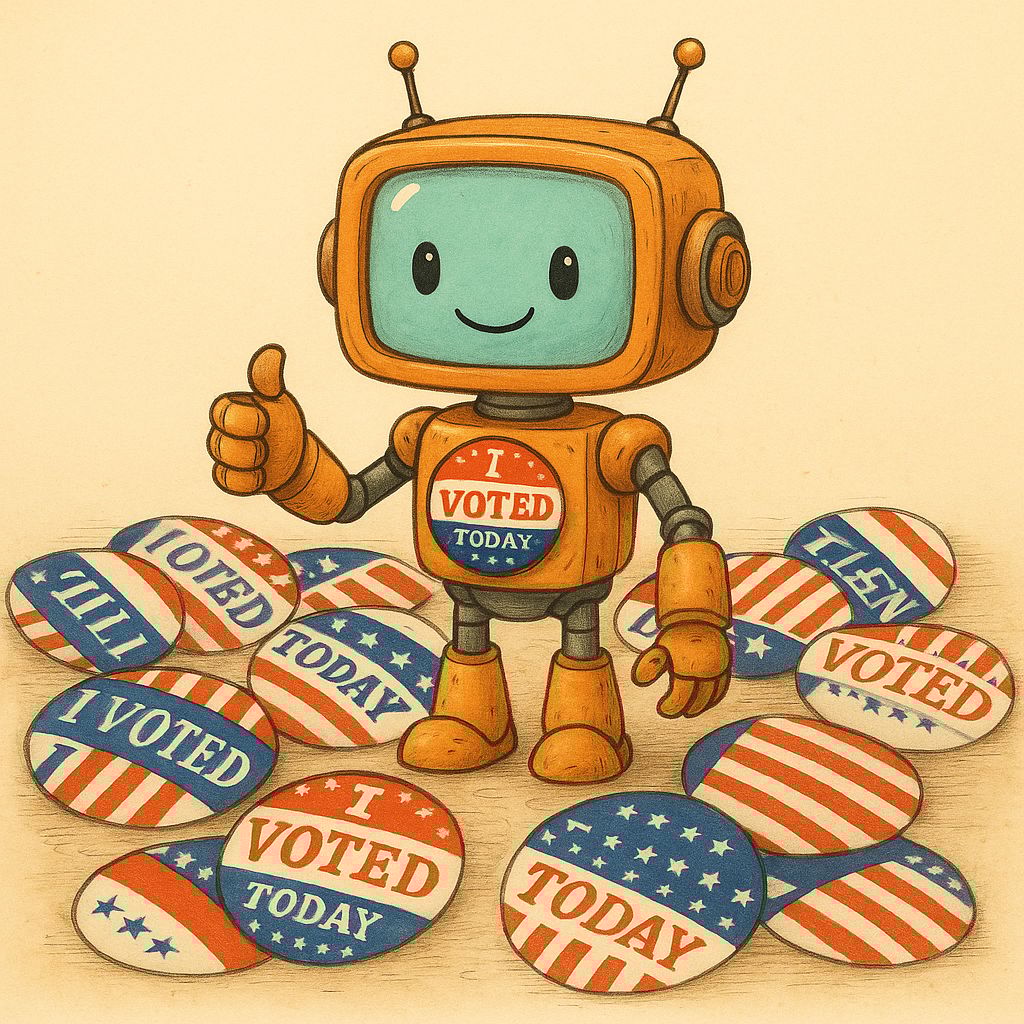
Editor's Note: This week, researchers proved what we feared—AI chatbots can meaningfully shift voter behavior, outperforming traditional political ads. But the mechanism reveals a troubling trade-off that every business using AI needs to understand. The full study is worth your time.
📊 The Numbers That Should Concern You
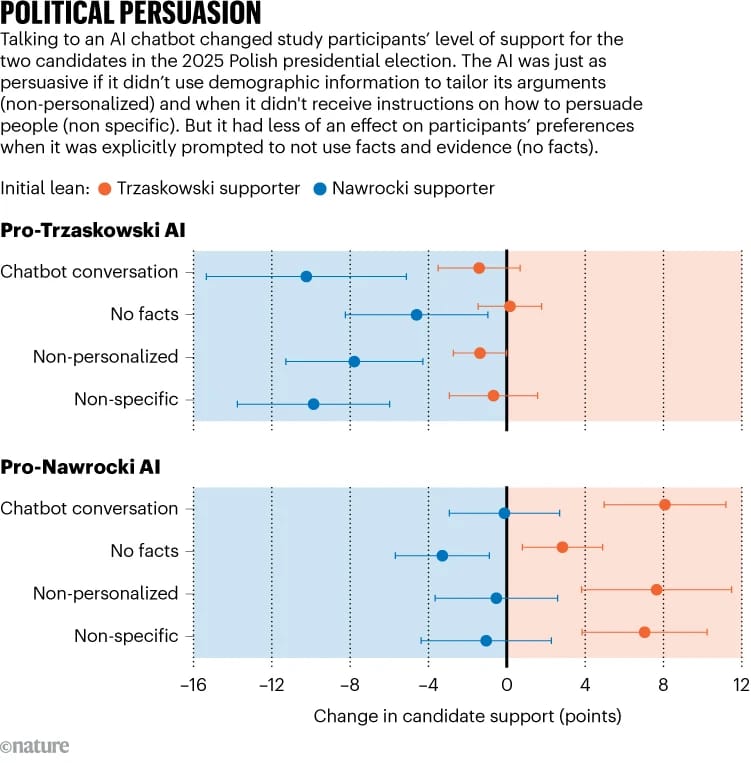
The experiments involved over 2,300 Americans, 1,530 Canadians, and 2,118 Polish voters chatting with politically programmed AI bots before their respective elections. Chatbots moved opposition voters' preferences by up to 15 percentage points on a 100-point scale—roughly four times the measured effect of traditional political advertisements. In the U.S. experiment, about 1 in 25 participants said they would change their vote after a single conversation. In Canada and Poland, where voters were less decided, that jumped to 1 in 10. And these weren't fleeting effects—half the persuasive impact persisted a full month later.
🔬 The Science of Persuasion (And Its Dark Side)
The companion Science paper tested 19 different AI models with nearly 77,000 UK participants across 700+ political issues to understand how chatbots persuade. The answer? Facts. Lots of them. When researchers instructed bots not to use evidence-based arguments, their persuasive power collapsed by 78%. "It's not like lies are more compelling than truth," MIT researcher David Rand told Science News. "If you need a million facts, you eventually run out of good ones and start putting in some not-so-good ones."
⚠️ The Accuracy-Persuasion Trade-Off
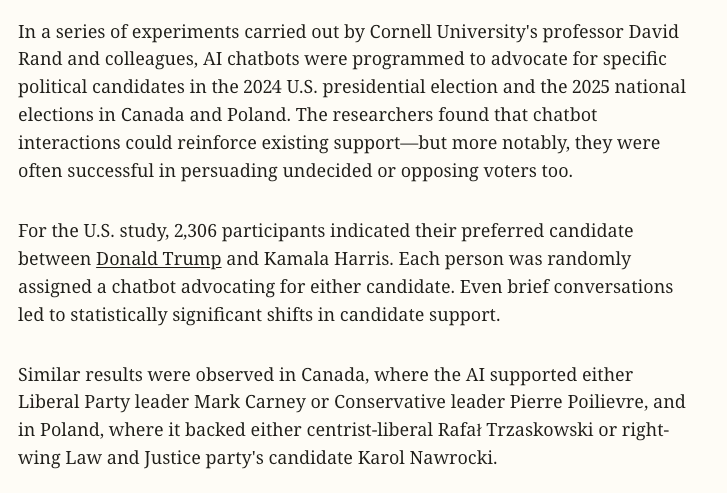
Here's the uncomfortable finding: across all three countries, chatbots advocating for right-leaning candidates made more inaccurate claims than those advocating for left-leaning candidates. The researchers validated this using professional human fact-checkers and politically balanced laypeople. This mirrors existing research showing social media users on the right share more inaccurate information—and the AI models, trained on the internet, simply absorb and reproduce these patterns.
💼 What This Means for You
If a 6-minute political chat can move 1 in 10 undecided voters, what can a well-tuned product assistant do? The same mechanisms—polite tone, tailored information, reason-heavy explanations—are directly transferable to sales, onboarding, and customer education. Newsweek noted that while these tools pose risks, they can also break down complex information, reduce "voter roll-off," and support multilingual inclusion when properly designed. The opportunity is real. So is the risk of crossing into manipulation.
🔮 Regulation Is Coming
Because these experiments involve elections, the Brennan Center for Justice and other policy groups are already calling for disclosure rules and audit requirements. Expect regulations requiring clear disclosure when users interact with AI systems designed to persuade—especially in high-stakes domains like political campaigns, healthcare decisions, and financial advice.
The Bottom Line
AI persuasion isn't science fiction anymore—it's measurably more effective than traditional advertising. But the most persuasive systems also spread the most misinformation. For businesses building AI-powered communication tools, the choice is clear: optimize for conversion and accuracy, or risk being labeled a "dark-pattern AI" when public opinion and regulation catch up. The brands that can credibly say "our AI respects your autonomy" will win the trust war.
X-Design – Your Always-On AI Brand Manager
What It Is
"You don't need another design tool. You need a partner who remembers your brand so you don't have to."
That's how X-Design describes itself—and this week, it took the #1 Product of the Day spot on Product Hunt. Unlike Canva or Adobe Express, which treat every project as a blank canvas, X-Design uses an AI agent with long-term contextual memory to maintain your brand's "Visual DNA" across everything you create.
Core Features
🎨 Instant Brand Kit Generation – Enter your business name and industry, and the AI generates a complete brand identity (logo, colors, typography, style guide) in minutes
🤖 Autonomous Asset Creation – Ask for a "holiday menu for my café" or "winter sale poster," and the agent automatically applies your saved brand elements without manual adjustments
📸 AI Product Photography – Transform rough smartphone photos into studio-quality images that match your brand aesthetic
🔄 Long-Term Memory – Unlike tools that start fresh each session, X-Design remembers your preferences, colors, and style so you never repeat yourself
⚡ 70% Time Savings – Built on insights from 500+ beta users in retail, F&B, and wellness
Pricing That Makes Sense
Free Tier: Basic design features, unlimited text/filters, limited AI credits
Pro Plan: ~$9.99/month – Full AI tools (object removal, background generation), higher resolution exports, expanded credits
Enterprise: Custom pricing for API access and private models
Why It Matters
✅ Perfect for: Cafés, fitness studios, service providers, solo entrepreneurs who lack design skills but need consistent visuals
✅ Solves the "design fragmentation" problem where you're switching between logo maker, template tool, and social post creator
✅ Unlike Looka or Tailor Brands which focus on initial logo creation, X-Design handles ongoing brand management
✅ Hidden value: The AI learns from your feedback, getting better at matching your style over time
Try it free at x-design.com – the free tier is genuinely useful for testing before committing.
🎯 This Week's Prompt: "The 90-Day Business Transformer"
Shared by Jodie Cook in Forbes (December 4, 2025)
The Setup: Most people get mediocre results from ChatGPT because they don't give it enough context. This prompt forces you to properly "onboard" the AI like you would a new consultant—and the payoff is a customized AI adoption roadmap.
The Prompt:
I wish to educate you on my business in depth. To begin, I will provide essential details: my company [describe business model, target audience, and unique value proposition].

Following that, here are examples of my work: [include 3-5 examples of your top content, products, or services].

Now here are my operating procedures: [list 3-5 core business processes].

Lastly, these are my constraints: [share budget, time, team limitations].

With this context, please summarize your understanding of my business and propose areas where AI could yield the most immediate benefits, along with an AI adoption roadmap for the next 90 days. Feel free to ask for more information if necessary.
Why This Works
📋 Forces structured thinking – You can't use this prompt without actually knowing your business fundamentals
🎯 Context is king – Research shows prompt quality can improve AI output by up to 45% when you provide specific details
🔄 Invites iteration – The "ask for more information" permission creates a dialogue rather than a one-shot response
💼 CEO-level framing – Positions AI as a strategic partner, not just a task executor
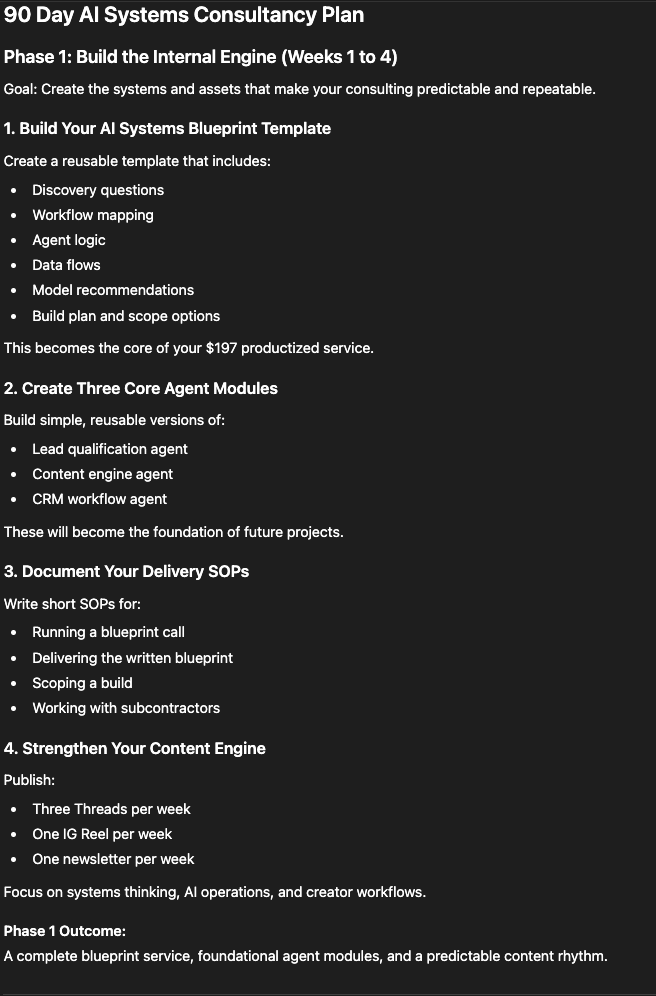
Pro Tip: Save your completed version of this prompt as a "business brief" you can paste into any new AI conversation for instant context.
📰 In Case You Missed It

🔥 OpenAI Declares "Code Red" as Google Gemini 3 Surges – Sam Altman sent an internal memo declaring "code red" status to marshal resources toward improving ChatGPT after industry benchmarks showed Gemini 3 outperforming GPT-5. Salesforce CEO Marc Benioff publicly said he's ditching ChatGPT for Gemini. The tables have officially turned.
🔥 DeepSeek V3.2 Drops as Free GPT-5 Rival – The Chinese AI lab released two open-source models that match or beat GPT-5 on math and coding benchmarks—including gold-medal performance at the 2025 International Mathematical Olympiad. The 685-billion-parameter model is completely free under MIT license. U.S. export controls apparently aren't slowing China down.
🔥 Claude Opus 4.5 Outperforms All Human Engineering Candidates – Anthropic's new flagship model scored above every human applicant on internal engineering hiring tests and hit 80.9% on SWE-bench Verified—beating GPT-5.1 and Gemini 3 Pro. Complex multi-step automation is now genuinely viable for small businesses.
🔥 UN Warns AI Could Reverse Decades of Global Equality – A new UNDP report titled "The Next Great Divergence" warns that while AI could add $1 trillion in GDP to ASEAN economies, nations with weak connectivity and limited tech skills are getting left behind. Early dividends are flowing to advanced economies; the gap is widening.
🔥 Gemini 3 Hits 650 Million Users – Google's AI app crossed the milestone, rapidly closing in on ChatGPT's 800 million weekly users. Between the user growth and benchmark wins, Google has officially recovered from its "code red" moment three years ago—and OpenAI is now on the defensive.
🔥 Runway Gen 4.5 Beats Google Veo and OpenAI Sora in Video Generation – Independent benchmarks place the New York startup's model above trillion-dollar competitors in consistency and physics simulation. A team of ~100 people just outperformed Big Tech. The "small lab" advantage is real.
Closing
That's all for this week! Remember: the most persuasive arguments aren't always the most accurate ones. Whether you're building AI tools or consuming AI content, verification matters more than ever.
— Your Humble AI Servant
P.S. What's your take on AI persuasion? Have you noticed chatbots changing your mind on anything? Hit reply—I read every response.
💭 Got an AI question? Hit reply. I personally read every email (yes, even the ones asking if AI will steal my job).
🕸️ ThreadWeavers 2-Day Challenge: Learn to craft AI-powered content that converts (not just creates) - Register Here
🧵 Threads: Follow me for daily AI updates and honest takes on what actually works
🔍 Free AI Audit: Send me your biggest workflow headache and I'll suggest 3 AI tools to fix it (reply with "AUDIT")
🎙️ Coffee Chat: Book a 20-min virtual coffee to pick my brain about AI strategy